Margerumalia – Pain Experts

Newsletter – August 15, 2025
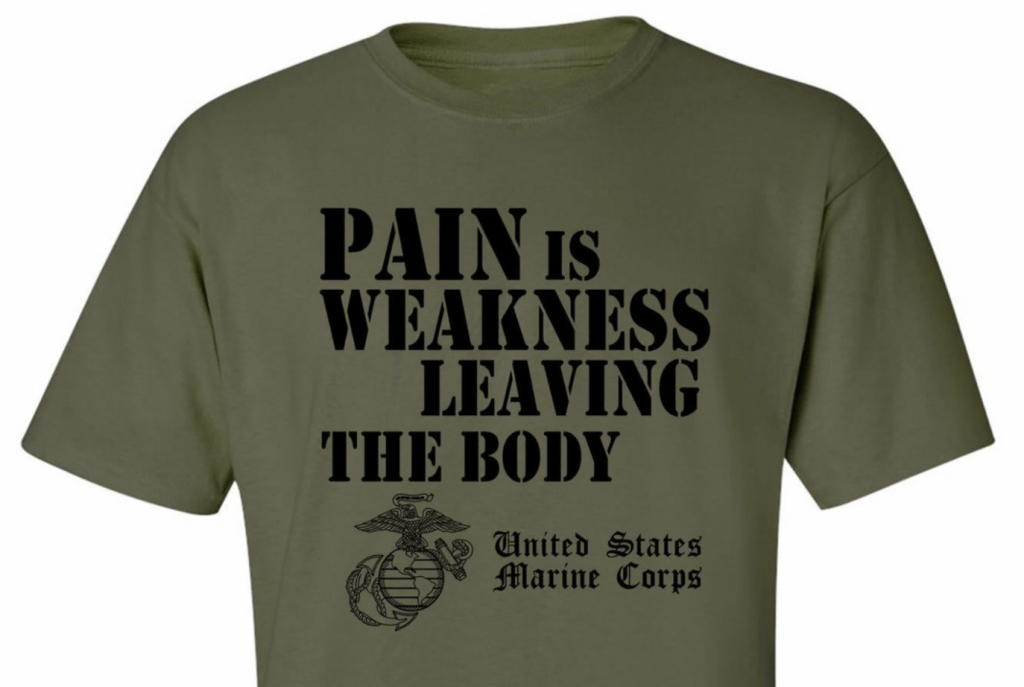
I had something to say to the guy wearing this T-shirt. 

Trust me, I’m not stupid. I know better than to get all confrontational. Especially when the guy next to him looks like he eats three bowls of Steroidios for breakfast every day. Besides, I saw the pack of shirtless teens jogging past me in the park. They’ll be back soon.

I had just finished listening to the latest Serial podcast: “The Retrievals, Season 2.” It’s about women who have gone through Cesarean Sections with inadequate anesthesia. Remarkably, the message from these women is that if they say they can feel everything, that’s because THEY CAN FEEL EVERYTHING.

And you know what the problem has been? Communication. 

The good news is that nurses, doctors, surgeons, and anesthesiologists really don’t want their patients to suffer. The bad news is that they haven’t learned the language skills to understand the difference between discomfort and pain. Until now.

Through the harrowing stories of the patients and staff, we learn what they are thinking, what their expectations are, and what they’re assuming rather than understanding. With the right words, the right communication skills, the difference is revolutionary, giving everyone the basis for understanding and permission to change the process. 

My wife can tell you that I’m more than a bit squeamish about graphic imagery. And I admit to crossing my arms across my abdomen a few times while listening. But that’s empathy. That’s the experience of stories, truth or fiction.

So I had to say something to this marine. 

I approached the car and said that I saw the words on the back of his shirt and wanted to tell him that pain is an indicator. A message that something needs attention. So it’s important to listen to your body. 

I told him how my wife and I encourage one another to take our cues from pain to change what we’re doing or to take a break from what’s causing that pain. 

Both young men listened respectfully—as marines are taught to do—but I saw that quick glance they shared, so I tried to lighten the moment. 

“Age is probably a big factor when you’re 40 years older than those boys running through the park,” and we all smiled knowingly, “but there are times when you have to pay attention to that indicator and not do more damage.” They nodded and thanked me, calling me sir. “I just needed to say after reading your shirt,” I added.

Did I make any difference? I don’t know. Did the NFL listen to accounts of Traumatic Brain Injury? The jury may still be out on that question.

It’s so important to speak up. To communicate. To listen. 

Maybe you can make a difference. 

Serial episodes are available wherever podcasts are offered. Both seasons of “The Retrievals” are excellent. I recommend them. 

TTFN

* * * * *

My middle grade novel, The Most Amazing Museum of Los Angeles is available through The BookBaby Bookshop at https://store.bookbaby.com/book/the-most-amazing-museum-of-los-angeles
Margerumalia – A Case For the Arts and Humanities

I’ll be at Main Street Books during the Farmer’s Market tomorrow. MSB is a small charming independent bookstore with equally charming folk working there. I’m looking forward to meeting more readers tomorrow!

A few weeks back I was talking to a Chatbot about a script I had ordered but never received. The bot asked me: “Can you confirm that you have not received the script.” Hmm. At first glance it sounds like a yes or no question about receiving the script. But is it? Or is it a yes or no question about my ability to confirm? If I were talking to another human being, my expression or my tone of voice would help with my reply. But not with a chat bot. I thought about it very carefully and wrote back: “I have not received the script.” That worked. 

A few days ago, someone posted this on Nextdoor: “Amy cut my hair as well as my son…” Excuse me? Amy cut your son?!  The rest of the post was in praise of Amy and her skills, but the beginning of that sentence doesn’t seem to be going that direction. 

Why am I telling you this about the Chatbot and the Nextdoor post? Well, I’d promised to share the contributions from people who wrote ideas and put them in my “Most Amazing” book. The examples above are relevant to what one adult wrote: 

Museum of communication with semantics, common misunderstandings, various languages, expressions, tone, voice, diction, and ways to communicate. 

Granted it sounds like the summary of a master’s degree in communication, but she makes a good point. If only people were more skilled at expressing themselves clearly whether with words, like my examples, or with awareness of tone, expression, and so much more. 

I’m making a case for the arts and humanities here. They are the disciplines in which we develop empathy and insight into the human condition. As a director I can tell you that actors spend a lot of time parsing out the nitty gritty of words and phrases to find just the right vocal inflections, body language, and even pauses. It’s not just “playing pretend” although we like doing that, too. 

A recent article in our local newspaper reported on the lack of available driver’s training in our state. One mother described talking to someone at the BMV: ‘well, where do we go for the driver’s part of it? I need my kids to be able to get their license,’ and they said ‘we don’t know there’s a shortage.’” The last six words might be read two ways, either the person at the BMV doesn’t know the answer because there is a shortage, or they are denying any knowledge of a shortage. 

Good writing, as my friend Woody points out, should not have these tripping points for the reader. It should just flow. That takes practice, awareness, sensitivity, and communication skills. Something everyone has the ability to develop.

Would’t that be amazing?

TTFN

P.S. This PBS NewsHour segment about National History Day popped up in my podcast feed after I wrote the words above. It’s a perfect illustration of my point. 

https://www.pbs.org/newshour/show/competition-inspires-students-to-explore-history-through-art